

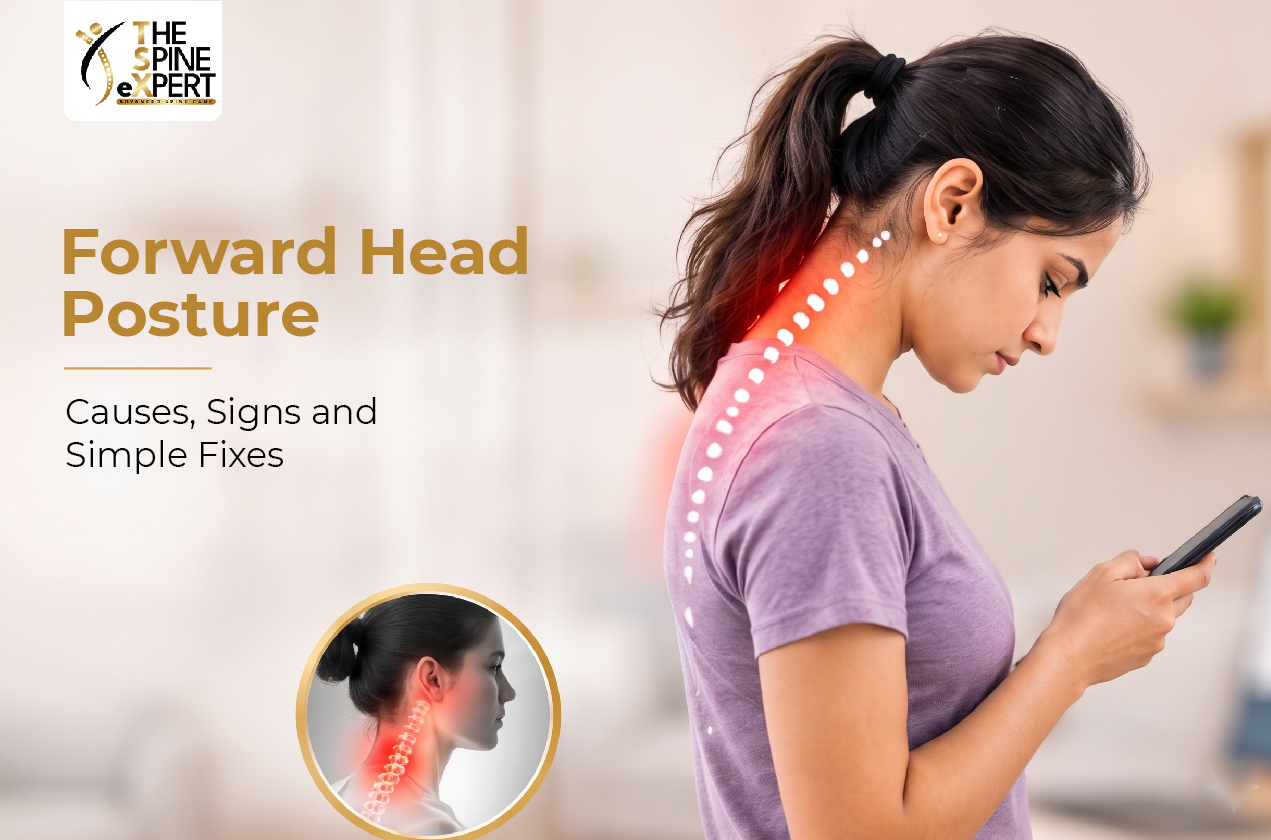
Forward head posture can strain your neck and upper back. Learn the causes, signs, simple exercises and when to see a doctor.

Forward head posture can strain your neck and upper back. Learn the causes, signs, simple exercises and when to see a doctor.
When you step into any office, on the train or in a café you will see people looking down at their phones/laptops, slouching with their heads, hunched shoulders and elongated necks. Forward head posture has become one of the most common postural issues in modern life. This can cause neck pain, stiffness, headaches and tension in the shoulders and upper back.
The good news is that forward head posture can be improved by making some lifestyle changes and doing some simple exercises. Dr. Zahir Abbas Merchant a spine expert at The Spine eXpert Clinic, Mumbai having over 15 years of experience in the field of orthopaedics will explain why this occurs, how to test your own neck posture at home, some exercises which will help improve this condition and when to seek advice from a doctor.
Forward head posture, also called forward neck posture, is when your head sits in front of your shoulders instead of directly above them. In good posture, if you look at someone from the side, their ear lines up roughly over the middle of the shoulder. With forward head posture, the ear sits noticeably in front of that line.
You may also hear it called “text neck” or nerd neck, nicknames that reflect how often it is linked to screens and desk work.
How can just a few centimeters make such a big difference? The average weight of your head is between 4.5 and 5.5 kg. If it is positioned right above the spine, it will not strain the neck muscles much. However, the more you tilt your head forward, the bigger burden it places on the neck. It is thought that tilting the head forward by 45 to 60 degrees, which occurs when one checks his/her phone, increases the strain in the neck several times. In order for one to hold the head in position, the back parts of the neck and upper back must always be strained.
You can get a good idea of your neck posture with two simple checks.
The wall test. Stand close to a wall so that there is an approximate distance of 5 – 10 cm between the wall and your heels. Place your buttocks and shoulder blades against the wall. You will now feel the back part of your head. If your head rests comfortably on the wall, then your posture is correct. If you have to tilt your chin up or strain to bring your head back, you likely have some degree of forward head posture.
The side photo. Get someone to photograph you from the side when you are standing in a natural stance. Picture a straight line being drawn from your ear. If it falls well in front of your shoulder, your head is sitting forward.
Such tests can be helpful as a basis for your further investigation but they do not amount to a diagnosis. Should you suffer from any pain, numbness, etc., further examination will be your best bet.
Bending the head down while on the phone for many hours throughout the day can be considered one of the most common causes. With every text that you have to read and with each scroll in your social media accounts, your neck muscles get extended and strained, respectively. Over months and years, the body adapts to this position as being standard.
The laptop computer is one of the key culprits because the monitor screen is low, forcing you to lower your gaze. The monitors that are kept far or at a low level, the chairs which do not provide back support, and the prolonged time spent without resting also cause you to lower your head.
Bending towards the steering wheel, particularly when there is traffic or during long drives, causes the head to move forward. In the nighttime, sleeping on an excessively raised pillow or a pile of pillows keeps the neck flexed forward for many hours. Stomach sleeping also causes strain on the neck.
Additional risk factors may be weak muscles of the upper back and deep neck, tightness of the chest muscles, carrying heavy loads, and in some instances, past neck injury or aging of the spine.
Not everyone with forward head posture has pain, but common symptoms include:
In case of recurrent or increasing neck pain, it would be worthwhile considering a professional assessment of your neck, rather than tolerating the pain. Bad posture can also be a cause for back pain, especially for upper and mid back pain due to the increased load on the muscles.
As the head remains in a forward position, the amount of pressure on the cervical vertebrae is increased, which might lead to:
Forward head posture is not the cause of any spinal disorders in itself, although the additional stress might exacerbate pre-existing medical conditions or accelerate the wear and tear process. Those who have cervical spondylosis – a condition characterized by the wear and tear of the discs and joints in the neck – would feel increased pain when they adopt poor posture. Excessive pressure on the discs might be linked to certain conditions like the slipped disc in the neck region, which could cause arm pain.
If you’re wondering how to fix forward head posture, the answer is rarely one single exercise. Lasting improvement comes from changing the positions you spend most of your day in, and supporting those changes with targeted exercises. Here’s how to improve neck posture in everyday life.
The pillow should be designed to support the neck. The pillow must support the curvature of the neck and prevent forward movement of the head when one is lying on their back. When lying on one’s side, the pillow should be supportive to the distance between the ear and the shoulder. Do not lie on your stomach.
These forward head posture exercises will help strengthen your weak muscles and stretch your tight muscles which force your head to be positioned forward. Neck posture exercises are easy and don’t require any special equipment; they can be done at any place either at your home or at your place of work. Do them cautiously because you should avoid doing those that cause sharp pain or dizziness.
Chin tucks are the most important exercise to correct forward head posture, because they train the deep neck muscles that hold your head in line.
You can also try this while lying down on your back, putting the back of your head against the pillow.
Tight chest muscles draw the shoulders and head forward.
Strong upper back muscles help hold the shoulders back and support good neck posture.
These correct neck posture exercises work best when done consistently, ideally every day. Combined with better habits, they are the most reliable forward head posture fix. If you aren’t sure how to correct neck posture safely, or you have pain while exercising, physiotherapy can help. A physiotherapist can assess your posture, identify which muscles are weak or tight and build a personalised programme of forward neck posture exercises for you.
Posture-related stiffness generally gets better with the modifications described above. Consult a doctor if you have:
Seek urgent medical care if you have sudden weakness in your arms or legs, difficulty walking, or loss of bladder or bowel control.
Dr. Zahir Abbas Merchant from The Spine eXpert Clinic, Mumbai, will initially determine the cause through a thorough diagnosis process, and thereafter might go for an X-ray or MRI scan. Depending on the diagnosis, treatment will be provided using posture correction, physiotherapy, medications, and spine treatment.
Yes. For most people, their head being forward would be solved through exercise and a better work environment and lifestyle. For those who develop problems because of poor posture and issues with their spine, it will take time for them to be sorted out.
Most individuals experience a decrease in stiffness and pain after just a few weeks. However, physical transformation, especially that which is visible, normally takes two to three months of consistent physical practice and change of habits.
The two are very similar. “Text neck” is neck pain resulting from looking down at electronic devices such as mobile phones, and it is among the leading causes of forward head position. Forward head position, on the other hand, is an overarching term referring to the positioning of the head in front of the shoulders.
Yes. Headaches may result from muscular tension at the back of the neck and at the base of the skull, resulting in pain at the back of the head and even moving up to the forehead or behind the eyes.
Posture correction devices can assist you in maintaining proper posture; however, it will not assist you in developing muscles needed for good posture. You may even have noticed yourself having poor posture as a result of your muscles not being used. You can always talk to your physician or physiotherapist about this matter.
If your neck pain is persistent (lasting longer than 2-3 weeks), occurs regularly, or you also have arm pain, tingling, numbness, weakness, headaches or dizziness then you should seek medical advice.
The forward head posture is quite common among those who spend many hours using their phones or laptops or are even in their cars. Left unattended, this could cause you to suffer from neck pains, headaches, and stiffness. It might even put extra pressure on your neck discs and joints. However, there are a number of things you can do to reverse this posture, including having a good workstation design, using the right pillow, taking breaks, and exercising.
Are your problems of neck pain and posture bothering you on a daily basis? Consult with Dr. Zahir Abbas Merchant of The Spine eXpert Clinic in Mumbai. With his more than 15 years of experience in the field of orthopaedics, Dr. Merchant will help you get to the root cause of your problem and recommend the appropriate treatment for your healthy neck.
Discover home remedies for back pain, including gentle stretching, heat and ice, better posture and sleep tips. Learn what to …
Follow for more updates
Copyright © 2026 The Spine Expert – Advanced Spine Care
Design and Managed by DigiScrub

TOO FAR FROM OUR MUMBAI CLINICS?
“Get expert guidance for your spine problems without travelling to Mumbai.”
NOW AVAILABLE FOR PRIVATE ONLINE CONSULTATIONS
Book Appointment