
Learn when a slipped disc may need surgery, how minimally invasive options like microdiscectomy work, the risks, recovery, and when to see a spine specialist.

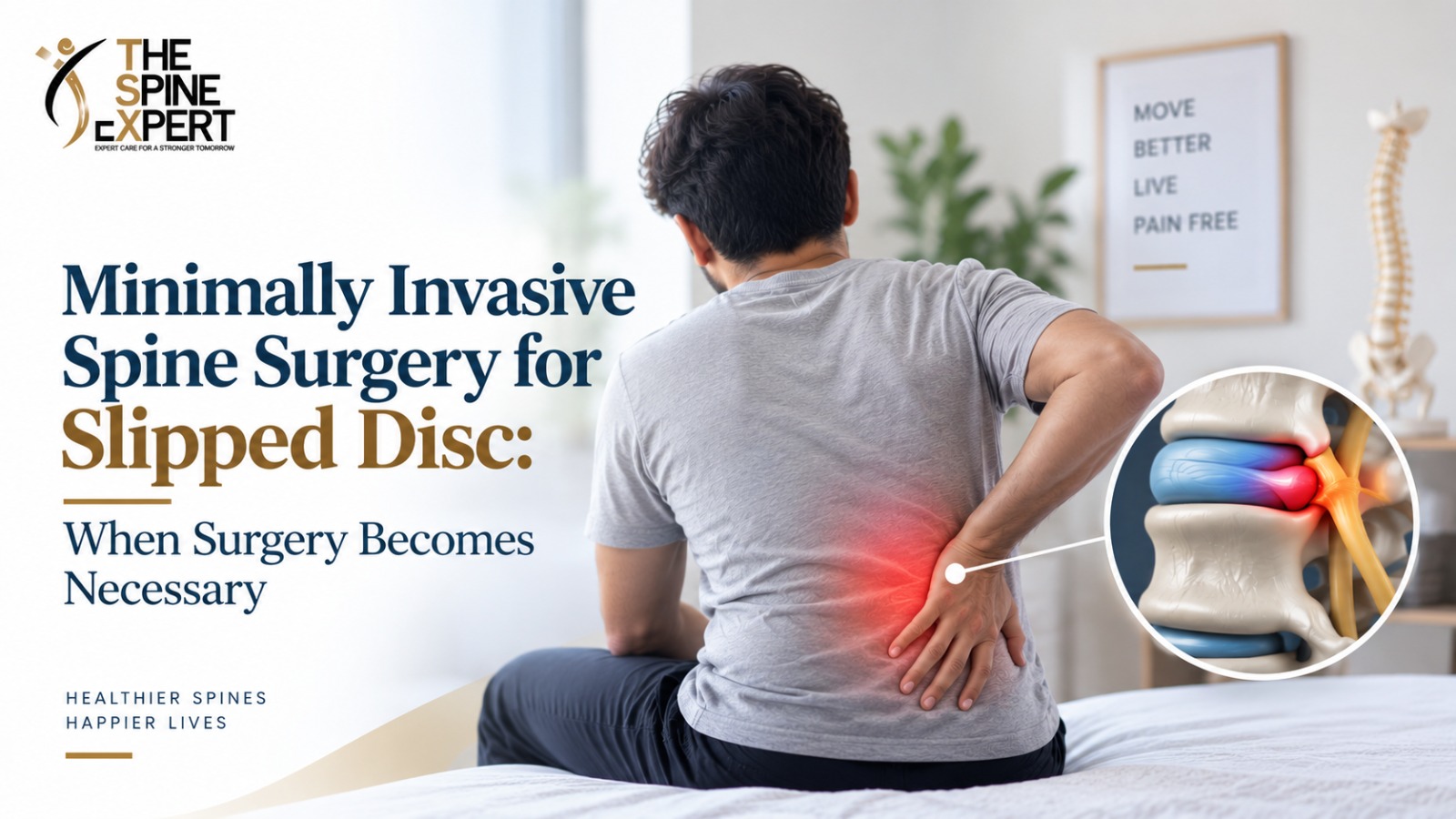
Being told you have a slipped disc can be worrying, especially if the pain is running down your leg or arm and making everyday life difficult. One of the first questions most people ask is, “Will I need surgery?”
For most people, the answer is no. Many slipped discs settle with time and non-surgical care. But for some patients, surgery becomes a reasonable or even necessary step. When it does, minimally invasive techniques allow surgeons to relieve pressure on the nerve through small incisions.
This guide walks through the full journey: what a slipped disc is, the symptoms it can cause, how it is usually treated first, when surgery may be considered, how minimally invasive procedures work, their risks, and what recovery involves. Every patient is different, so treatment decisions should always be based on your own diagnosis, symptoms, scans, general health, and a clinical assessment by a spine specialist.
What Is a Slipped Disc and Why Does It Cause Pain?
Your spine is made up of bones called vertebrae. Between them sit soft, round cushions called discs. Each disc has a tough outer layer and a softer, jelly-like centre. Discs absorb shock and allow the spine to bend and move.
A slipped disc, also known as a herniated or prolapsed disc, happens when part of the soft centre pushes out through a weak area or tear in the outer layer. Despite the name, the disc does not actually slip out of place.
If the displaced disc material presses on a nearby nerve, it can cause symptoms. A Mayo Clinic spine surgeon explains that the disc material can cause both pressure and inflammation around the nerve, which leads to symptoms in the back, leg, or arm.
Slipped discs are most common in the lower back, but they can also happen in the neck. Importantly, not every slipped disc causes symptoms. The NHS notes that many people have one and never know it.
Common Symptoms of a Slipped Disc
Symptoms depend on where the disc is and whether it is pressing on a nerve. They often affect one side of the body and may include:
- Pain that travels down the leg, from the buttock into the thigh, calf, or foot. When this comes from a disc in the lower back, it is called sciatica.
- Pain that travels into the shoulder, arm, or hand, when the slipped disc is in the neck.
- Numbness, tingling, or pins and needles in part of the leg, foot, arm, or hand.
- Muscle weakness, such as difficulty lifting the front of the foot or a weaker grip.
- Pain that worsens with coughing or sneezing, which Mayo Clinic lists as a common symptom of a herniated disc.
- Back or neck pain, which may be less severe than the leg or arm pain.
These symptoms can also be caused by other spine or nerve problems, which is why a proper examination is important.
Non-Surgical Treatment Comes First for Most People
The good news is that many slipped discs improve without an operation. Mayo Clinic notes that herniated disc symptoms usually get better over a period of weeks or months.
During this time, treatment usually focuses on relieving pain and keeping you moving:
- Staying gently active. Long bed rest is no longer advised. The NHS recommends starting gentle activity, such as walking, as soon as you can.
- Pain-relief medicines, as advised by your doctor or pharmacist.
- Physiotherapy, to improve movement, strengthen supporting muscles, and teach safer ways to sit, bend, and lift.
- Spinal injections, in some cases. NICE advises that epidural steroid injections may be considered for people with acute and severe sciatica. Relief varies from person to person and may be temporary.
Because so many people recover with this approach, surgery is usually considered only when there is a clear clinical reason for it.
When Does Surgery Become Necessary?
There is no single rule that applies to everyone. A spine surgeon will look at your symptoms, examination findings, MRI, general health, and how much the problem affects your life. Surgery may be considered in the following situations.
Emergency Nerve Compression: Cauda Equina Syndrome
Rarely, a large disc in the lower back presses on the bundle of nerves at the base of the spine. This is called cauda equina syndrome. It is a medical emergency and usually needs urgent surgery to relieve the pressure. The warning signs are listed in the red-flag section below.
Weakness That Is Severe or Getting Worse
When a disc presses hard on a nerve, the muscles it controls can weaken. In the leg, this may cause foot drop, where the front of the foot drags or slaps while walking. In the arm, it may cause a weak grip or difficulty lifting the arm.
The NHS notes that worsening muscle weakness or numbness is one of the reasons a doctor may refer you to discuss surgery. Weakness should be assessed promptly by a spine specialist.
Leg or Arm Pain That Does Not Improve With Non-Surgical Care
This is the most common reason people have surgery for a slipped disc. The UK’s National Institute for Health and Care Excellence (NICE) advises that spinal decompression may be considered for people with sciatica when non-surgical treatment has not improved their pain or function and when their scan findings match their symptoms.
Pain That Seriously Limits Daily Life
Some people have pain so severe that they cannot work, sleep, walk, or look after themselves despite medicines. Surgery may be discussed sooner in these situations, especially when the pain clearly comes from a compressed nerve.
When there is no emergency and no significant weakness, this is often a shared decision. It depends on how well you are coping, how quickly you need to recover, and your preferences after understanding the benefits and risks.
MRI Findings That Match Your Symptoms
A scan on its own is not a reason for surgery. A large review published in the American Journal of Neuroradiology found disc bulges in about 30% of pain-free 20-year-olds and about 84% of pain-free 80-year-olds.
Surgery is considered when the MRI shows a disc pressing on a nerve and this matches the exact pattern of your pain, numbness, or weakness. Disc surgery mainly aims to relieve leg or arm symptoms. If you have back pain alone, without nerve symptoms, it is less likely to help.
When Surgery May Be Considered: A Quick Guide
|
Your Situation |
What Usually Happens |
|
Numbness around the genitals, or new bladder or bowel problems |
Emergency assessment; urgent surgery is often needed |
|
Severe or worsening weakness in the leg or arm |
Prompt specialist assessment; surgery is often discussed early |
|
Leg or arm pain that is slowly improving |
Non-surgical treatment is usually continued |
|
Severe leg or arm pain not improving with non-surgical care, with a matching MRI |
Surgery may be offered as an option |
|
Back pain alone, without leg or arm symptoms |
Disc surgery is less likely to help; non-surgical care is usually preferred |
This table is a general guide. Your treatment plan should be decided with your spine specialist.
Early Surgery or Waiting Longer? What Research Shows
Two clinical trials published in the New England Journal of Medicine help explain this choice.
In a Dutch trial from 2007, 283 people with severe sciatica lasting 6 to 12 weeks were assigned either to early surgery or to continued non-surgical care with surgery later if needed. People who had early surgery got relief from leg pain faster. After one year, however, results were similar in both groups. About 39% of those in the non-surgical group went on to have surgery within that year.
A Canadian trial from 2020 studied people whose sciatica had lasted 4 to 12 months. Six months after enrolment, people who had a microdiscectomy reported average leg pain of 2.8 out of 10, compared with 5.2 out of 10 in those who continued non-surgical care.
Taken together, these trials suggest that waiting can be reasonable for many people whose symptoms have lasted a few weeks, with surgery mainly speeding up recovery. For people whose leg pain has lasted many months without improving, surgery may offer better pain relief than continuing non-surgical care.
How Minimally Invasive Spine Surgery Works
Minimally invasive spine surgery aims to treat the problem with less disturbance to the muscles and tissues around the spine.
In traditional open surgery, the surgeon makes a longer incision and moves a larger area of muscle away from the bone. In minimally invasive surgery, the surgeon works through a small incision. A narrow tube, called a tubular retractor, gently separates the muscles to create a working channel, or a thin camera called an endoscope is used. Magnification and X-ray imaging help the surgeon see the nerve and the disc clearly.
For a slipped disc, the goal is usually to remove only the fragment of disc pressing on the nerve, while leaving the rest of the disc in place.
Microdiscectomy
A microdiscectomy is one of the most commonly performed operations for a slipped disc in the lower back. Through a small incision, the surgeon uses an operating microscope to locate the compressed nerve, gently move it aside, and remove the disc fragment pressing on it. Many patients go home the same day or the next day.
Endoscopic Discectomy
Endoscopic spine surgery uses a thin tube fitted with a camera and light, inserted through a very small incision. The surgeon views the area on a screen while removing the disc material.
A 2026 analysis of 17 randomised trials, published in the journal Spine, compared endoscopic and microscopic discectomy. Both provided similar relief from leg pain. The endoscopic approach had fewer wound-related problems and patients returned to work about three weeks sooner on average, but it involved more X-ray exposure during surgery and did not show a consistent long-term advantage for pain or disability. Not every disc herniation is suitable for an endoscopic approach.
What About a Slipped Disc in the Neck?
A slipped disc in the neck can cause neck pain along with pain, tingling, or weakness in the arm and hand. When surgery is needed, the approach depends on where the disc is pressing.
If the disc fragment is off to one side, a posterior cervical foraminotomy may be suitable. The North American Spine Society describes this as a procedure done through a small incision at the back of the neck, sometimes using a tube, that relieves pressure on the nerve with minimal bone removal. In other cases, surgeons may recommend anterior cervical discectomy and fusion (ACDF), which removes the disc through the front of the neck and joins the two vertebrae together.
Comparing Common Procedures for a Slipped Disc
|
Procedure |
Area of Spine |
How It Is Done |
Involves Fusion? |
|
Microdiscectomy |
Lower back |
Small incision with an operating microscope |
No |
|
Endoscopic discectomy |
Mainly lower back; selected neck cases |
Very small incision with a thin camera |
No |
|
Posterior cervical foraminotomy |
Neck, when the disc presses to one side |
Small incision at the back of the neck, sometimes through a tube |
No |
|
ACDF |
Neck |
Incision at the front of the neck; disc removed and vertebrae joined |
Yes |
Inside the Operating Theatre: A Recent Procedure by Dr. Zahir's Team
Recently, Dr. Zahir and his surgical team performed a spine procedure, providing a real-world example of the precision and careful surgical planning involved in modern spine surgery.
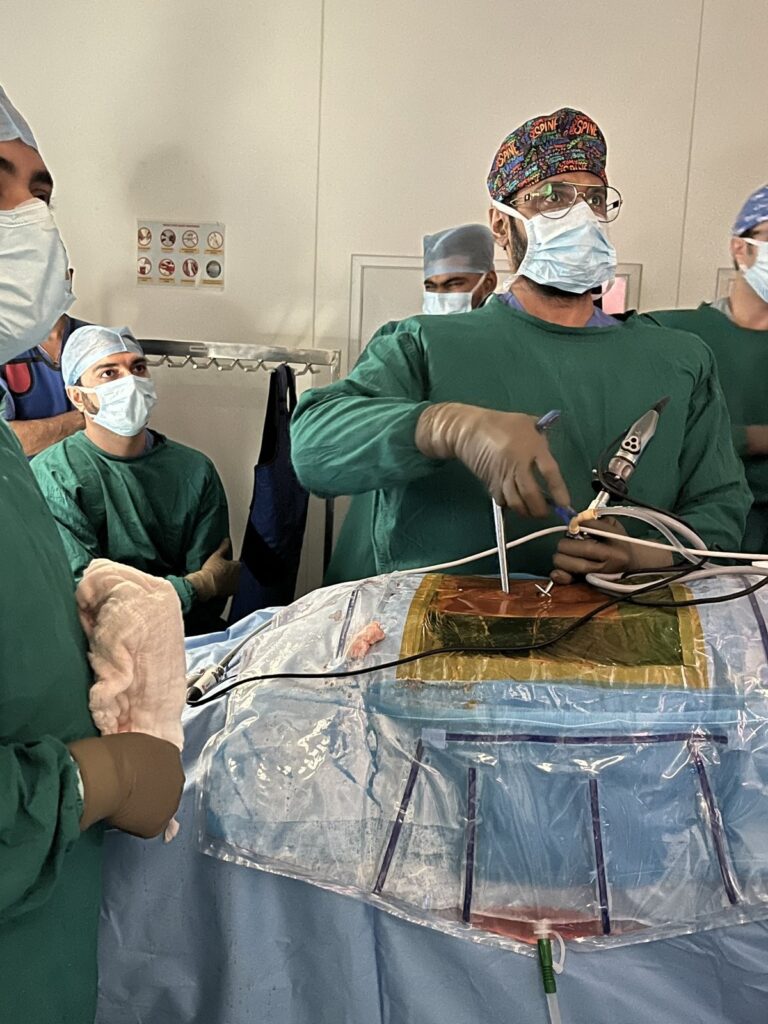
Dr. Zahir’s surgical team during a recent spine procedure. Spine surgery relies on close teamwork, with each member of the team following the procedure step by step.
Spine surgery does not begin in the operating theatre. Before any operation, the surgical team reviews the patient’s symptoms, examination findings, and scans to make sure the planned procedure matches the problem causing the symptoms. On the day of surgery, patient positioning, careful handling of delicate nerve tissue, and imaging to confirm the correct level of the spine are all part of making the procedure as safe and precise as possible. Good lighting, magnification, and a well-coordinated team all support this careful work.
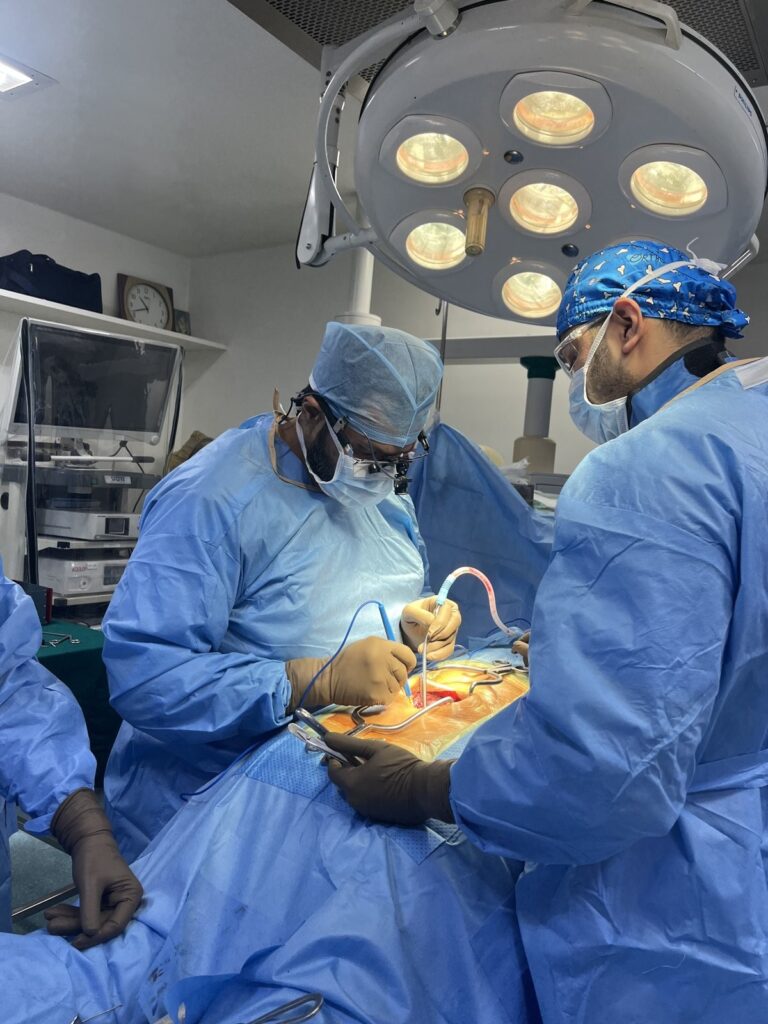
Surgeons from Dr. Zahir’s team working under operating-theatre lights during a recent spine surgery. Magnifying loupes and focused lighting help surgeons see fine structures clearly.
Moments like these are a reminder that every spine operation is individually planned. Not every patient with a slipped disc needs surgery, and when surgery is needed, the approach is chosen based on that person’s condition rather than a one-size-fits-all technique.
Potential Benefits of Minimally Invasive Surgery
For suitable patients, minimally invasive approaches are designed to offer several advantages over open surgery. Cleveland Clinic lists benefits such as less disruption to muscles and ligaments, smaller scars, less blood loss, less pain after surgery, and a shorter hospital stay and recovery time.
These benefits are usually most noticeable in the early weeks after surgery. For many disc operations, long-term pain relief is broadly similar between minimally invasive and open techniques, and each approach has its own trade-offs.
A 2014 review of randomised trials on disc surgery found low-quality evidence of higher rates of nerve root injury, dural tears, and repeat surgery with minimally invasive discectomy, and higher infection rates with open surgery. None of these differences were statistically significant. Johns Hopkins Medicine also notes that people with previous spine surgery or more complex spine problems may be better served by an open approach.
In short, minimally invasive surgery is not automatically better or safer. What matters is choosing the procedure that fits your specific problem, performed by a surgeon experienced in that technique.
Risks and Possible Complications
No spine surgery is risk-free, including minimally invasive surgery. Johns Hopkins Medicine lists possible risks of minimally invasive spine surgery that include:
- Infection
- Bleeding
- Nerve injury
- Blood clots
- Complications related to anaesthesia
- A tear in the covering around the nerves, which can leak spinal fluid
- Not getting enough pain relief
Recurrent Disc Herniation
After a discectomy, the remaining disc can herniate again. A recent systematic review reported that this happens in up to 15% of patients after a first discectomy, and some of them need a second operation. An earlier review found that smoking and diabetes were linked with a higher risk of recurrence.
Incomplete Recovery of Nerve Symptoms
Leg or arm pain often improves soon after surgery, but numbness and weakness can take longer to recover, sometimes several months. In some people they do not fully go away. Not everyone gets complete relief, whichever treatment they choose. In the Dutch trial described above, about 20% of all participants, across both the surgical and non-surgical groups, reported an unsatisfactory outcome at two years.
Surgery through the front of the neck can also cause a sore throat or difficulty swallowing for a short time. Your surgeon should explain which risks apply most to your situation.
Recovery After Minimally Invasive Slipped Disc Surgery
The First Few Days
Most patients are encouraged to get up and walk within hours of surgery or the next morning. After many minimally invasive disc operations, patients go home the same day or the next day. Some pain around the incision is normal and is usually managed with prescribed medicines.
The First Few Weeks
Walk regularly and increase the distance gradually. Avoid heavy lifting, bending, and twisting until your surgeon allows it. Avoid sitting in one position for long periods, and check with your surgeon before driving or returning to exercise. A structured physiotherapy programme is often recommended to rebuild strength and flexibility.
Returning to Work
According to the Spine Health Foundation, people who have lower back decompression surgery without fusion often return to light duties in around 2 to 4 weeks, moderate work in 4 to 6 weeks, and heavy work in about 8 weeks, or longer if more than one level was treated. Recovery after neck surgery, particularly fusion, may follow a different timeline.
Factors That Can Affect Recovery
Recovery is not the same for everyone. Factors that can influence it include:
- The type of procedure and how many levels of the spine were treated
- How severe the nerve compression was before surgery, and how long it had been present
- General health, including conditions such as diabetes
- Smoking, which slows healing and is linked with a higher risk of the disc herniating again
- The physical demands of your job and daily activities
- How closely you follow activity advice and your rehabilitation programme
When Should You See a Spine Specialist?
Consider seeing a spine specialist if:
- Your back or neck pain is not improving after a few weeks
- Pain is spreading into your leg or arm
- You notice numbness, tingling, or weakness
- Symptoms keep coming back or are affecting your work, sleep, or daily activities
- You have been advised surgery and want to understand all your options
The American Association of Neurological Surgeons recommends referral to a spine specialist if herniated disc symptoms last longer than four weeks.
Red-Flag Symptoms That Need Urgent Medical Attention
Go to an emergency department immediately if you have back pain along with:
- Numbness around your bottom, genitals, or inner thighs
- Difficulty passing urine, or loss of control over your bladder or bowels
- Weakness or loss of feeling in one or both legs that is severe or getting worse
- Sciatica in both legs
- Back pain that started after a serious accident or fall
See a doctor promptly if your back pain comes with a fever or chills, unexplained weight loss, pain that is worse at night, a history of cancer, or a weakened immune system.
Questions to Ask Your Spine Surgeon
- Is my slipped disc clearly the cause of my symptoms?
- What could happen if I continue non-surgical treatment for longer?
- Do I have any weakness or nerve changes that make surgery more urgent?
- Which procedure do you recommend, and why?
- Is a minimally invasive or endoscopic approach suitable in my case?
- What are the main risks for me, including the chance of the disc herniating again?
- When can I expect to go home and return to work?
Frequently Asked Questions
Can a slipped disc heal without surgery?
Yes, in many cases. Symptoms often improve over weeks to months with activity, pain relief, and physiotherapy. Surgery is usually considered only if symptoms do not improve, if weakness develops or worsens, or in an emergency.
How long should I try non-surgical treatment before surgery?
There is no fixed timeframe for everyone. In the major trials described above, people had sciatica for at least six weeks before surgery was considered. Surgery may be discussed sooner if pain is severe and uncontrolled, if there is significant weakness, or immediately in cauda equina syndrome.
Is minimally invasive surgery for a slipped disc safe?
It is a well-established treatment, but it is not risk-free. Possible risks include infection, bleeding, nerve injury, spinal fluid leak, and the disc herniating again. Your surgeon can explain your personal level of risk based on your health and condition.
Is minimally invasive surgery always better than open surgery?
No. It often means less muscle disruption and a quicker early recovery, but long-term results for many disc operations are broadly similar. Some patients, such as those with previous surgery or more complex spine problems, may be better suited to an open approach.
Can a slipped disc come back after surgery?
Yes. A recurrent disc herniation can happen at the same level after a discectomy. Staying active, keeping a healthy weight, not smoking, and following your exercise programme may help lower the risk, but they cannot prevent every recurrence.
Is keyhole or laser surgery the same as minimally invasive surgery?
“Keyhole surgery” is an everyday term often used for minimally invasive or endoscopic surgery through small incisions. A laser is a tool that may be used for part of some procedures, not a separate type of surgery. A 2019 review in the Journal of the American Academy of Orthopaedic Surgeons found no evidence that lasers give better results than conventional techniques.
How soon can I walk after slipped disc surgery?
Most people are encouraged to walk on the same day or the day after surgery. Short, regular walks are an important part of early recovery.
Book a Consultation